










As artificial intelligence tools become increasingly capable of writing code and building applications, developing legal case management software appears faster and more affordable than ever. But does faster development mean a system is ready to manage the daily operations of a law firm? Can AI-generated software deliver the same long-term security, sustainability, and reliability as a professionally engineered system?
These questions are no longer purely technical. They represent important business decisions for law firms and corporate legal departments, particularly when protecting confidential client information, managing legal cases, tracking court hearings, and maintaining financial records.
In this article, Law Surface examines the differences between legal case management software developed primarily using artificial intelligence and software built under the supervision of experienced programmers. We explore development costs, sustainability, security, maintenance, scalability, and long-term operational reliability.
1. Can Artificial Intelligence Build Complete Legal Case Management Software?
Modern artificial intelligence tools can generate programming code, design user interfaces, create database structures, integrate external services, and assist developers in identifying and fixing software errors.
Using these tools, it is possible to build an initial legal case management application that includes client registration, case tracking, hearing schedules, document management, and task assignments.
However, there is a fundamental difference between building software that works today and engineering a system that remains dependable for years.
Software quality should not be measured solely by its ability to perform basic functions. A reliable legal management system must also handle growing databases, multiple users, complex permissions, security threats, continuous updates, and evolving legal workflows.
Importantly, AI-generated code is not automatically insecure or unreliable. Similarly, software written manually by programmers is not automatically superior.
The real difference lies in software architecture, engineering standards, testing procedures, human oversight, and the ongoing responsibility for maintaining the system.
2. Software Sustainability: The Challenge Beyond Initial Development
Software sustainability is one of the most important factors when selecting legal case management software.
An AI-generated application may initially appear complete and functional. However, challenges often emerge as the number of users, legal cases, documents, and business operations increases.
For example, a law firm may eventually need to introduce advanced accounting features, integrate contracts with case records, implement additional user permissions, or connect its software with external government platforms.
If the original application was developed without a structured architecture, these modifications may become difficult and potentially affect existing functionality.
Professionally engineered systems are typically designed with scalability, maintainability, database integrity, and modular development in mind.
This allows developers to introduce new capabilities while reducing the risk of disrupting existing operations.
Software sustainability is not simply about keeping an application running. It is about maintaining, securing, and improving the system as business requirements evolve.
Both AI-assisted and traditionally developed software can achieve long-term sustainability when supported by appropriate engineering practices and qualified technical teams.
3. Development Costs: Is AI-Generated Software Really Cheaper?
One of the main advantages of AI-assisted software development is the potential to reduce initial development time and costs.
AI tools can accelerate repetitive programming tasks, generate application prototypes, and help smaller development teams deliver functional demonstrations.
However, the initial development cost represents only part of the overall investment.
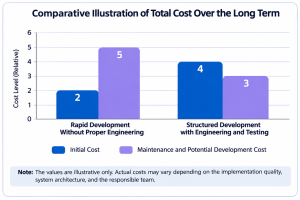
An application developed quickly at a low initial cost may become expensive if its architecture requires significant restructuring or repeated corrections.
Conversely, a properly engineered system may require a higher initial investment but can reduce unexpected maintenance costs and operational risks.
Law firms should therefore evaluate the Total Cost of Ownership (TCO) rather than focusing exclusively on the initial purchase or development price.
The actual costs depend on the complexity of the application, the quality of its implementation, and the expertise of the team responsible for maintaining it.
4. Data Security and Client Confidentiality
Legal case management software processes highly sensitive information, including client records, legal documents, contracts, financial transactions, confidential correspondence, and litigation details.
Protecting this information is essential for law firms and legal departments.
AI-generated code may contain vulnerabilities that are difficult to identify without professional review, including insufficient access controls, insecure database queries, or unintended exposure of confidential information.
However, these vulnerabilities can also exist in manually written software.
Effective software security depends on implementing appropriate technical and organizational safeguards, including:
- Secure authentication and role-based access controls.
- Data encryption where appropriate.
- Regular code reviews and security testing.
- Audit logs for sensitive operations.
- Reliable backup and recovery procedures.
- Continuous monitoring of software dependencies and security updates.
Organizations must also consider the confidentiality implications of using external AI development tools, particularly when source code or sensitive information is shared with third-party services.
For legal professionals, software security is not an optional feature. It is a fundamental requirement for protecting client confidentiality and maintaining operational trust.
5. Continuous Development and Understanding Legal Workflows
Legal case management software differs significantly from general business applications.
Law firms operate within complex workflows involving litigation procedures, court hearings, judgments, enforcement actions, legal expenses, attorney fees, client communications, and jurisdiction-specific requirements.
Although artificial intelligence can generate a case registration form or hearing calendar, it does not independently guarantee an accurate understanding of the relationships between these legal processes.
This is where specialized human expertise becomes particularly important.
Experienced software teams do more than write code. They analyze business requirements, understand operational challenges, design appropriate workflows, and translate feedback from legal professionals into practical solutions.
A successful legal management platform requires continuous improvement based on actual user needs, systematic testing, and carefully planned updates.
Adding new features quickly is not necessarily the same as improving the software.
6. Reliability: What Happens When the Software Fails?
Evaluating software when everything works correctly is relatively easy.
The real test comes when unexpected problems occur.
What happens if a database update fails? What if an important document cannot be retrieved? What if a newly introduced feature affects an existing accounting function?
Applications developed without sufficient documentation, testing, and monitoring may be difficult to troubleshoot, regardless of whether their code was written by AI or human programmers.
Well-engineered software can benefit from automated testing, error monitoring, version control, rollback procedures, and disaster recovery plans.
These practices help technical teams identify problems, restore functionality, and reduce operational disruption.
No software system can guarantee that failures will never occur.
However, the ability to detect, manage, and recover from failures is an essential measure of software reliability.
7. AI-Developed vs. Professionally Engineered Software: A Comparison
The following comparison examines two development approaches: rapid AI-driven development without sufficient engineering oversight, and structured software development managed by qualified technical professionals, potentially with AI assistance.
| Comparison Factor | AI-Driven Development Without Adequate Oversight | Professionally Engineered Development |
|---|---|---|
| Development speed | Often faster for initial prototypes | Requires structured planning and testing |
| Initial cost | Potentially lower | May require a larger initial investment |
| Sustainability | Depends heavily on architecture and documentation | Considered throughout system design |
| Security | Greater risk without professional review | Structured security controls and testing |
| Scalability | Can become difficult without proper architecture | Designed to accommodate future growth |
| Bug fixing | May be difficult without documentation | More systematic debugging processes |
| Legal workflow understanding | Requires guidance from legal specialists | Benefits from domain expertise |
| Ongoing maintenance | Depends on available technical resources | Can follow established maintenance processes |
| Long-term reliability | Uncertain without engineering governance | Improved through testing and continuous maintenance |
This comparison does not suggest that AI-generated software is inherently inferior.
A system developed with substantial AI assistance can achieve excellent quality when supported by experienced engineers, proper documentation, comprehensive testing, and responsible maintenance.
8. The Hidden Risks of Choosing Software Based on Price Alone
When selecting law firm management software, some organizations focus primarily on subscription fees or initial development costs.
However, lower upfront expenses do not necessarily translate into better long-term value.
Potential risks include dependence on a single developer, limited documentation, difficulty migrating data, inadequate technical support, and compatibility issues following software updates.
These challenges can become particularly serious when a system contains years of legal case histories, confidential documents, financial records, and client information.
Before investing in any legal management platform, organizations should assess whether it offers clear procedures for data export, backup management, system documentation, maintenance, and future development.
The ability to retain access to business-critical information is especially important when changing software providers or upgrading infrastructure.
9. Should Law Firms Avoid AI-Developed Software?
Not necessarily.
Artificial intelligence has become a valuable resource in modern software engineering.
When used responsibly, AI can help development teams accelerate coding tasks, generate automated tests, analyze errors, improve documentation, and increase productivity.
The distinction is between using AI as an engineering tool and relying on generated code without adequate review or accountability.
The most balanced approach combines the efficiency of artificial intelligence with the expertise and responsibility of professional software engineers.
In this model, AI assists with development activities while qualified professionals remain responsible for architecture, security, testing, performance, maintenance, and long-term technical decisions.
The objective is not to choose between humans and artificial intelligence, but to build dependable software using the most appropriate tools and expertise.
10. How to Choose Sustainable Legal Case Management Software
Before selecting legal case management software for a law firm or corporate legal department, decision-makers should look beyond the appearance of the application and its advertised features.
Important questions include:
- Does the software have a clear history of updates and improvements?
- Is there a responsible technical support and maintenance team?
- Can the organization recover its data following a system failure?
- Can the platform accommodate additional users and new functionality?
- Are appropriate information security measures implemented?
- Can the system be updated without compromising existing records?
- Does the software support the legal workflows relevant to the organization?
It is also important to test the software using realistic operational scenarios.
A legal management system should be capable of supporting case management, court hearings, client records, document management, tasks, contracts, and legal accounting within a coordinated working environment.
The best choice is not necessarily the application with the longest feature list or the lowest price.
It is the system that can support current operations while remaining adaptable to future requirements.
11. Law Surface: Legal Case Management Software Built for Continuous Development
At Law Surface, legal case management software is approached as a long-term operational platform rather than a collection of individual screens and functions.
The platform brings together case management, client records, court hearings, documents, tasks, contracts, and legal accounting in a unified environment designed for law firms and corporate legal departments.
Law Surface continues to improve its capabilities and introduce new features in response to the operational requirements of legal professionals.
The platform also provides cloud-based and on-premises deployment options, allowing organizations to select an operating environment that aligns with their technical and business requirements.
The objective is to simplify legal operations, improve access to information, reduce repetitive administrative work, and support efficient collaboration while maintaining a focus on software stability and data protection.
Ultimately, the value of legal software should not be judged solely by how its code was produced.
It should be measured by the quality of its architecture, its suitability for legal workflows, and the commitment to maintaining and improving the platform over time.
Conclusion: Choose Legal Software for Long-Term Value, Not Just Development Speed
Artificial intelligence has transformed software development by making application creation faster and more accessible.
However, it has not eliminated the need for professional engineering, security testing, specialized expertise, or long-term planning.
Building a basic legal case management application in a short period may be achievable.
Developing a dependable system that supports a law firm for years requires much more than generating code.
The real investment is not simply in software that works today at the lowest possible cost. It is in a secure, scalable, sustainable system that can grow alongside your legal practice.
Explore the features of Law Surface or start your free 14-day trial to discover how an integrated legal management platform can support your daily operations.